
Katie Hawkins // December 11, 2025

I know the struggle, my friends. If saying, “Time to do your chores!” feels like the opening scene of World War III, you are in good company! But if we’re keeping it real, as believers our homes should look vastly different at chore time than the rest of the world.
Chores are an incredible opportunity to teach our kids that work is not drudgery — it’s a call to stewardship and servanthood. I’m right in the middle of teaching these principles in my own home, and trust me, no one here keeps a perfect attitude about cleaning (myself included!). Still, I hope you find some encouragement in this post. It is possible to cultivate joy and purpose in the everyday work God has given us.
God’s Good Design for Work
The truth is, God called us to meaningful work from the very beginning (Genesis 2:15). Even before sin entered the world, work was part of life — and it was good.
When we look at work (and in this case, chores) through the lens of Scripture, we see that work is tied to our God-given purpose. Explain to your children that chores honor God through faithful stewardship of what He has entrusted to us. He gave us food, a home, toys, clothes… and it is our responsibility to take care of them.
The Bible also calls us to “serve one another humbly in love” (Galatians 5:13). Household chores are a simple, beautiful way to show love to each other and to function as a team.

Cultivating Gratitude and a Heart of Service
Chores are a surprisingly powerful way to cultivate grateful, servant-hearted kids — but this culture starts with us.
One of the most effective tools? Your language.
Language shapes atmosphere. When you begin saying things like:
- “Let’s take good care of what God has given us.”
- “I’m so thankful we have a kitchen to clean and food to eat.”
- “Lord, thank You for this home… these toys… these clothes…”
—you fill your home with gratitude. Children absorb that.
And what about cultivating a heart of service?
The most powerful teacher is your example. As you complete your own work, your posture can reflect the humility of Philippians 2:3–4:
“Do nothing out of selfish ambition or vain conceit. Rather, in humility, value others above yourselves…”
When our kids see us loving and serving our family by taking care of everyday tasks with humility, consistency, and even joy, it absolutely shapes how they approach their own responsibilities.
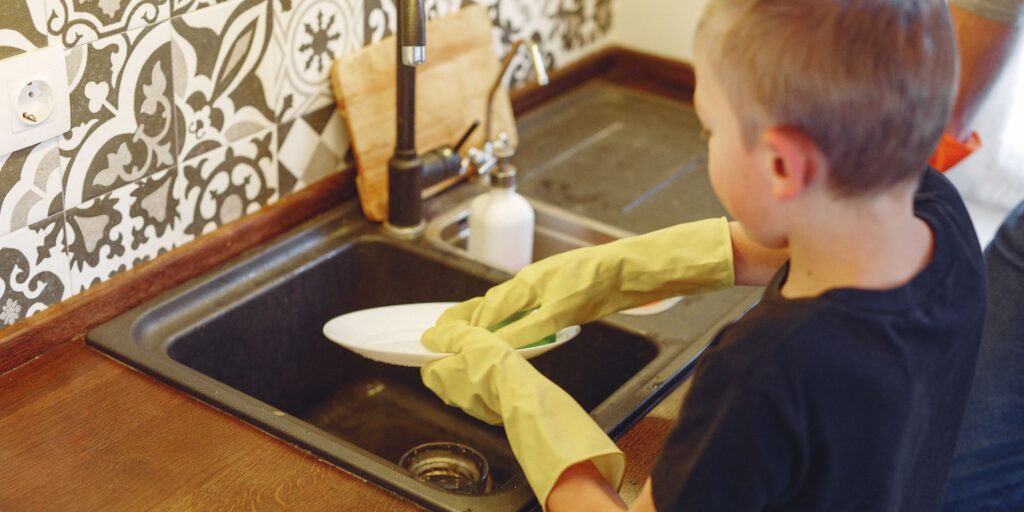
Practical Ways to Make Chores Meaningful
1) Integrate chores into the rhythm of your day.
Decide if chores happen:
- At the same time each day (before school, after breakfast, etc.)
- Spread throughout the day (feed pets in the morning, tidy at lunch, trash after dinner)
- Or a mix — which is what many families find works best
The key is simply this: give your children daily, predictable responsibilities.
2) Assign age-appropriate tasks that build both skills and character.
Setting the dinner table does more than teach where the fork goes.
It teaches servanthood and hospitality.
Watering the garden teaches more than how plants grow.
It teaches patience and nurture.
Cleaning a toilet teaches more than sanitation.
It teaches humility.
Chores are never just chores. They’re character-formation opportunities disguised as everyday tasks.

3) Reinforce the why behind the work using Scripture and conversation.
Many adults look back on their childhood and say, “I just never understood the heart behind the command.”
What a gift it would be if our children grew up understanding God’s purpose for everyday work! Imagine them loading a dishwasher or mowing a lawn someday with Colossians 3:23–24 echoing in their hearts:
“Whatever you do, work at it with all your heart as working for the Lord…”
We have the opportunity to plant those seeds now.
4) Use visual chore charts and routines that promote independence.
Kids may resist structure, but they absolutely thrive within it.
A simple chart or checklist removes confusion, clearly communicates expectations, and helps children take ownership of their work.
Be creative, keep it visual, and be their accountability when they forget — because learning responsibility is a process.
Start Today — Even if It’s Messy
If you haven’t integrated daily chores into your home yet, today is a perfect day to start. It will take time for your kids to work without complaining and to develop a grateful heart. (We’re still very much a work in progress over here!)
But as we encourage our children to give their best, as we show them God’s heart for obedience and service, and as we teach them life skills they’ll carry into adulthood…
God will bless our efforts.
You’ve got this, friend. And the way you’re shaping your home? It matters more than you know.
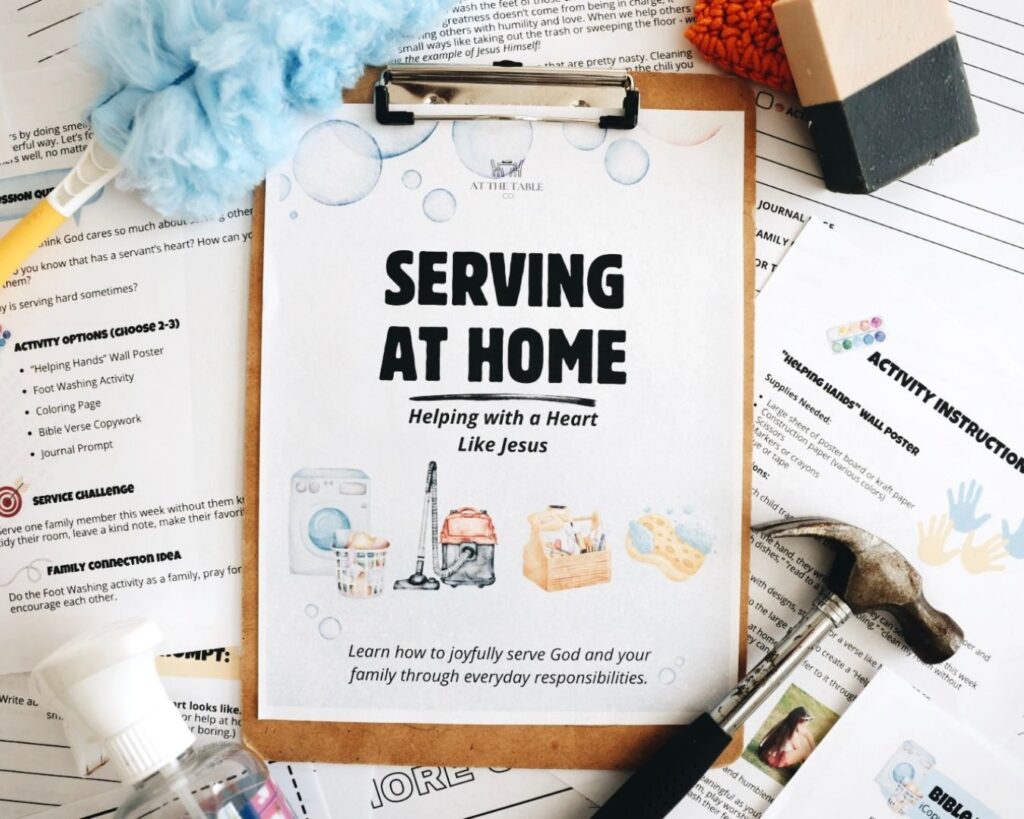
Looking for a simple way to help your kids steward your home with grateful hearts?
Serving at Home: Helping With a Heart Like Jesus is a hands-on, Bible-centered unit study designed to bring purpose, peace, and teamwork back into your daily routines.